Edited by Dr. Mayasari Abdul Majid, Library Director, LSL Library

iPads, e-readers, tablets, and educational apps have become a normal part of children’s lives. Technology has transformed the way children learn, communicate, and access information. As parents and educators, however, we are often left with an essential question: Does reading on a screen provide the same experience and cognitive benefits as reading a physical book?
The answer is more nuanced than simply saying that paper is good and screens are bad. Both formats have a meaningful place in a child’s learning journey. However, research increasingly suggests that the medium matters, particularly for younger children and when the purpose of reading is deep comprehension, sustained attention, language development, and shared social interaction.
The core question is not whether we should choose books or technology. It is about helping children understand when to choose a physical book and when a digital resource is more appropriate.
1. The Brain on Paper vs. Screens: Why the Medium Matters
Reading is not simply about seeing words on a surface. For a young child, reading is a multisensory and social experience. A child holds the book, turns the pages, looks at illustrations, listens to an adult’s voice, asks questions, points to pictures, and connects the story to their own lived experiences.


A physical book provides a stable, predictable environment for these interactions. The child can move backwards and forwards through the pages, handle the paper, and develop a spatial sense of where a particular story event or piece of information is located.
Tactile Page Turning + Spatial Layout + Uninterrupted Focus = Deeper Narrative Mapping & Comprehension
Research strongly supports the importance of this physical experience:
- Lower Comprehension in Basic Digital Transfers: Furenes, Kucirkova, and Bus (2021) conducted a meta-analysis of 39 studies involving 1,812 children aged 1 to 8. Their findings showed that when digital books were essentially digital transfers of print books, children demonstrated lower comprehension when reading digitally compared to print.
- The Importance of Adult Co-Reading: Furenes et al. (2021) also highlighted that adult support during print-book reading was particularly valuable. Reading is rarely just an interaction between a child and a text; it is an interaction between a child, a book, and another human being.
- Early Social-Emotional Bonding: The American Academy of Pediatrics (AAP, 2024) emphasises that shared reading beginning in infancy supports language, cognitive, and social-emotional development while strengthening relationships between children and caregivers.
2. Does This Mean Digital Reading Is Bad?
No. Digital reading can be extremely useful. E-readers and tablets give children immediate access to vast digital libraries, which is particularly convenient during family travel. Digital platforms also provide vital accessibility features such as adjustable font sizes, text-to-speech, contrast settings, and tools that support learners with additional needs.
Research shows that digital reading should not be dismissed as ineffective. A systematic review by Hare et al. (2024) examined 88 studies involving children and adolescents aged 1 to 17. Across the studies, no single medium consistently emerged as superior in every situation. Findings varied according to age, text type, task requirements, and digital design quality.
Rather than asking: “Is paper better than digital?”
The better question is: “What kind of reading are we asking the child to do?”
| Reading Goal | Recommended Medium | Primary Cognitive Benefit |
| Bedtime Stories & Early Literacy | Physical Paper Book | Calms the nervous system, aids bonding, builds spatial story memory. |
| Deep Narrative Study & Focus | Physical Paper Book | Minimises digital distractions, encourages sustained attention span. |
| Travel & Portable Library | E-Reader / Tablet | High convenience, immediate access to diverse titles. |
| Research & Quick Reference | Digital Platforms | Rapid cross-referencing, searchability, multimedia integration. |
| Accessibility & Inclusion Needs | Digital Tools | Adjustable text sizing, contrast control, text-to-speech tools (Hare et al., 2024). |
3. Developmental Stages: From Infancy to Secondary School
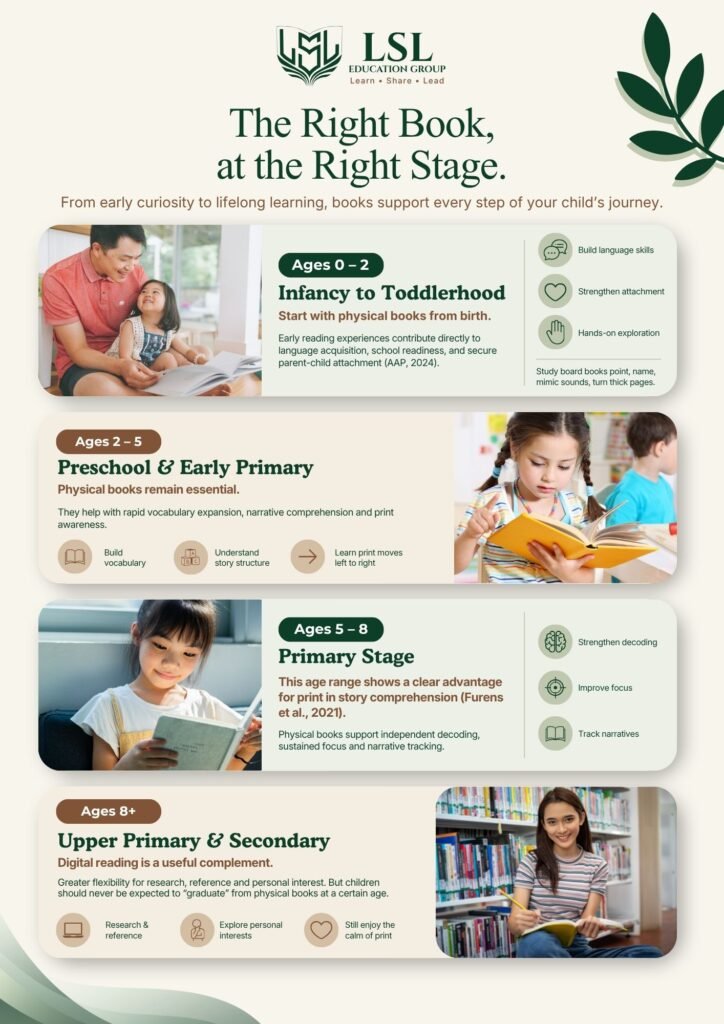
Infancy to Toddlerhood (Ages 0–2)
Start with physical books from birth. Early reading experiences contribute directly to language acquisition, school readiness, and secure parent-child attachment (AAP, 2024). For babies and toddlers, sturdy board books provide hands-on opportunities to point, name objects, mimic sounds, and turn thick pages.
Preschool & Early Primary (Ages 2–5)
Physical books remain essential during this stage of rapid vocabulary expansion, narrative comprehension, and print awareness. The physical presence of a book helps children understand that text moves from left to right and that physical pages hold fixed story concepts.
Primary Stage (Ages 5–8)
This age range represents the exact window examined in the Furenes et al. (2021) meta-analysis, which found a clear advantage for print in story comprehension when digital books were simple equivalents of print books. Physical books support independent decoding, sustained focus, and narrative tracking.
Upper Primary & Secondary (Ages 8+)
For older children, greater flexibility naturally emerges. Digital reading becomes an increasingly useful complement for research, reference, and personal interest. However, children should never be expected to “graduate” from physical books at a certain age. A Year 10 student can benefit from an e-book for academic research and still gain immense cognitive relaxation from reading a printed novel before bed.
4. Knowing When to Choose Each Medium
Choose a Physical Book For:
- Reading for pure pleasure and leisure.
- Bedtime reading routines.
- Developing early literacy and phonics decoding.
- Longer narrative novels requiring imagination and reflection.
- Shared parent-child or sibling reading sessions.
Choose Digital Reading For:
- Travelling and holidays where packing space is limited.
- Quick reference and factual research.
- Accessing rare or specialized learning materials.
- Utilizing accessibility features (font enlargement, screen contrast, text-to-speech).
By matching the medium to the learning goal, we help children build a balanced, lifelong relationship with both print and digital tools.