
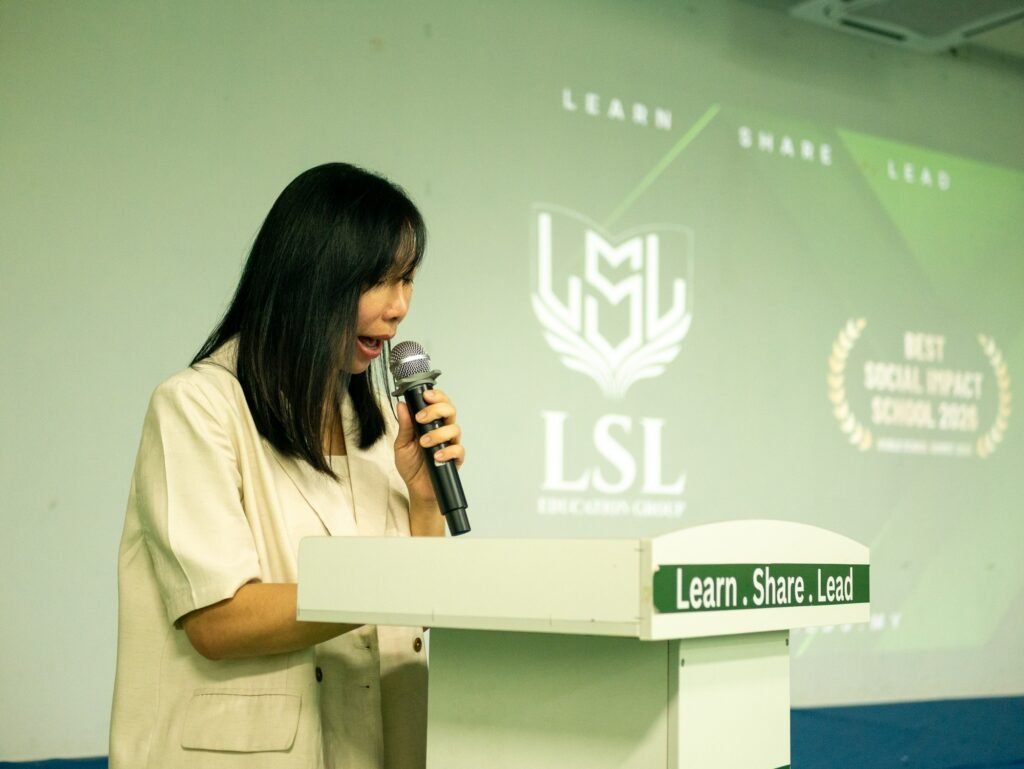
At Lead International School, we believe that education is a beautiful, shared journey between the home and the classroom. To support our community in navigating modern digital challenges, including the rising concern of screen addiction in children, we recently hosted a dedicated Parenting Talk at our school campus. This event brought together our wonderful international school community of parents, teachers, and leading educational experts to address the modern challenges families face today.
Our discussions focused on a central question many parents ask: How to raise children who are academically capable, emotionally balanced, morally grounded, and socially responsible in a digital world?
During the session, we emphasised that true education extends far beyond textbooks and traditional classrooms. Instead, our collective focus must be on nurturing a child’s mind, heart, and character to build lifelong resilience and empathy.
Celebrating Social Impact and Our Community Partnership
We opened the event by celebrating the incredible achievements of our school community. Our esteemed guest speaker, Prof. Dr Loh, warmly commended our collective efforts, extending her heartfelt congratulations to our school team, and our active parent network for their vibrant engagement in student development.
We were also deeply honoured to share notes of appreciation regarding our recent recognition as the Best in Social Impact School at the World School Summit 2026. This award highlights how effectively our school programmes empower students to positively engage with, support, and impact the wider social environment.
What Can I Do to Manage Tantrums and Screen Addiction in Children?
Our Parenting Talk featured deep-dive sessions led by two of Malaysia’s experts in educational psychology and counselling, who provided invaluable guidance for our families:
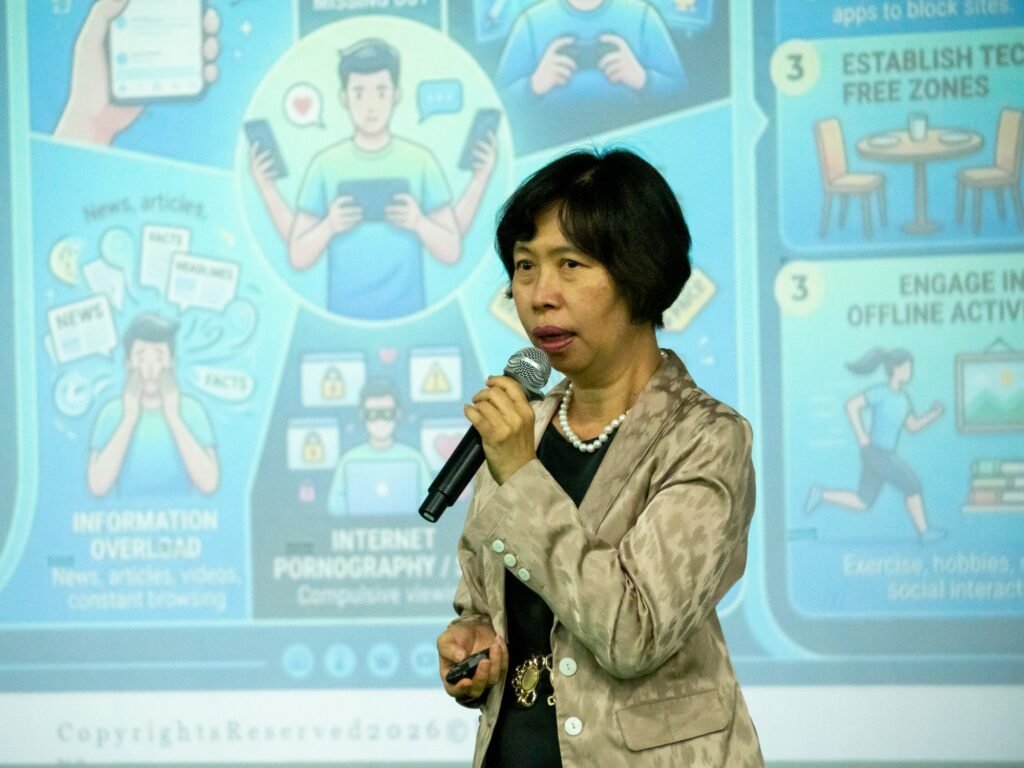
- Prof. Dr Loh: A full professor at the Department of Educational Psychology and Counselling at Universiti Malaya, and Director to the ASEAN University Network Disability and Public Policy Network.
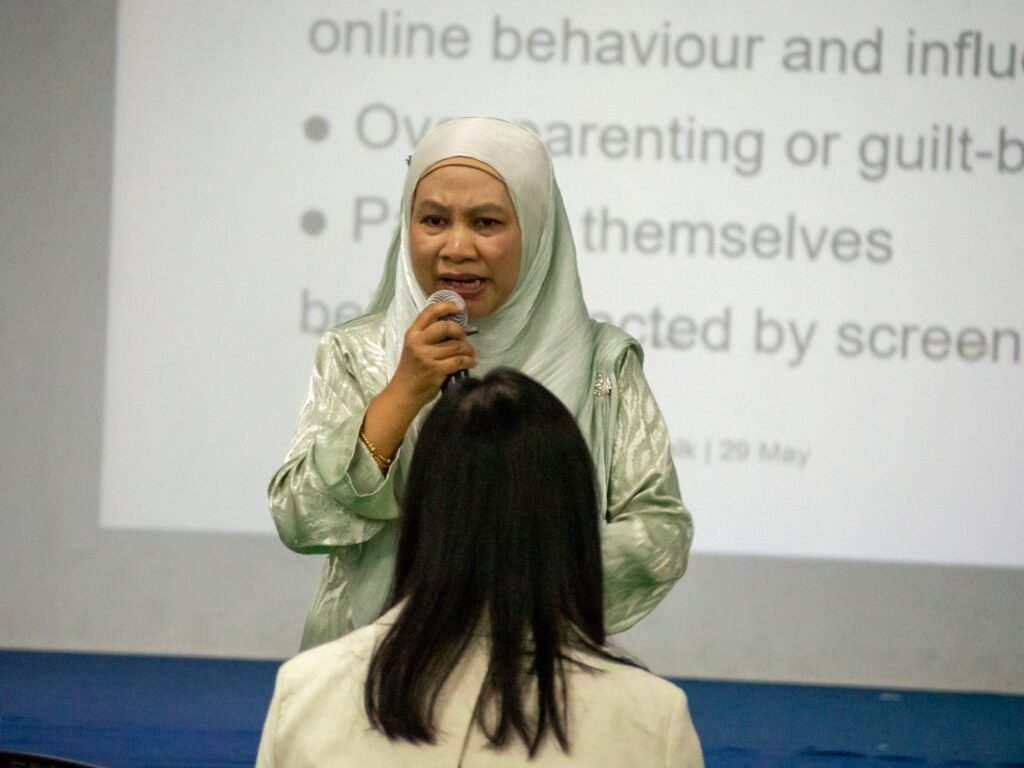
- Prof. Dr Siti: Head of the Department of Counsellor Education and Counselling Psychology at Universiti Putra Malaysia.
Deconstructing Behavioral Challenges: Why Children Exhibit Tantrums and Disrespect
When behavioural challenges shift as a child grows, parents frequently ask how to handle intense moments of conflict. While intense outbursts of anger and frustration are common developmental phases for toddlers, emotional dysregulation, defiance, and tantrums in children are increasingly manifesting today.
To effectively support your child, both speakers highlighted that these outbursts are rarely just bad behaviour. Prof. Dr Loh explained that they are frequently linked to deep-seated feelings of frustration, learned helplessness, or an inability to communicate effectively, which is particularly common for children with special needs or autism.
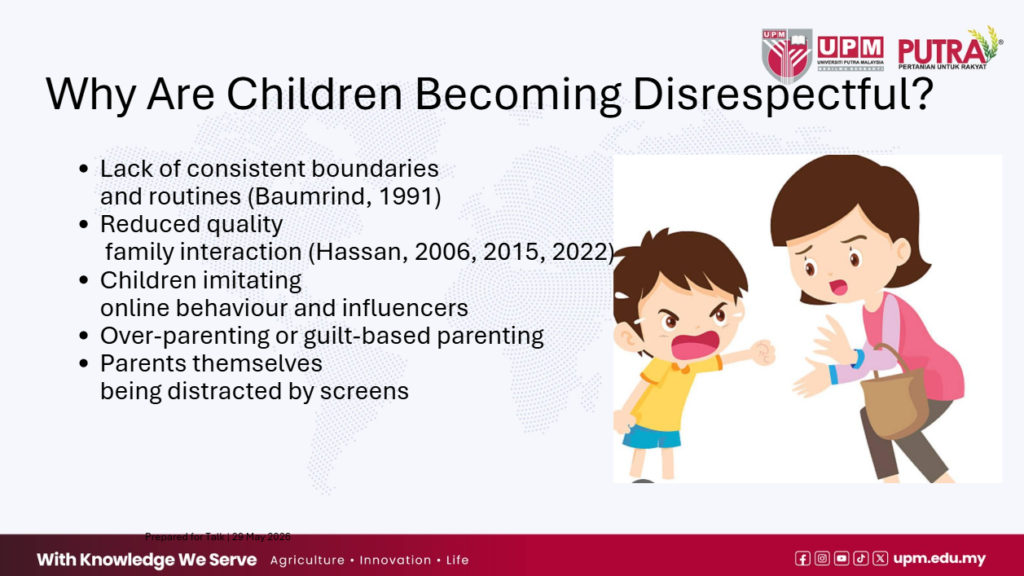
Expanding on the family ecosystem in her presentation, Why Are Children Becoming Disrespectful?, Prof. Dr Siti identified key societal and environmental root causes:
- Lack of Consistent Boundaries: A shortfall in maintaining steady, predictable routines and structural boundaries at home.
- Reduced Quality Family Interaction: Fewer moments of deep, uninterrupted face-to-face bonding between parents and children.
- Imitating Online Behaviour: Children absorbing and replicating the negative attitudes or defiant behaviours of digital influencers.
- Over-Parenting or Guilt-Based Parenting: Allowing parental guilt to compromise healthy, firm boundaries.
- Screen-Distracted Parents: Adults themselves being overly absorbed in digital devices, unintentionally modelling disconnected tech habits to their children.
Guiding with Love: Relational Blueprints for Home Discipline
To rebuild a culture of mutual respect without reverting to fear-based or authoritarian parenting styles, both experts shared structured, compassionate frameworks for the home.
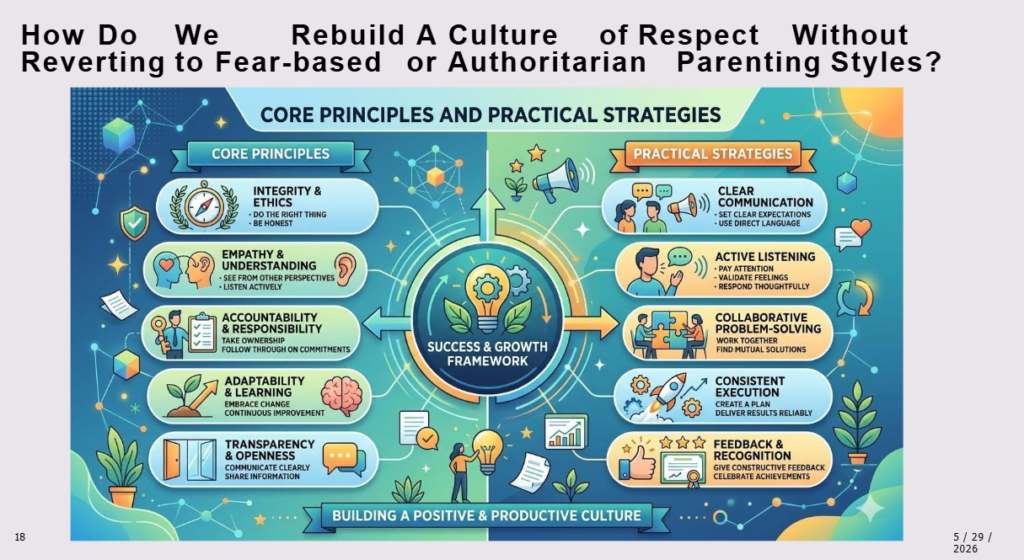
1. Core Principles to Adopt
- Integrity & Ethics: Do the right thing and model honesty in your daily life.
- Empathy & Understanding: Actively listen to your child and make an effort to see things from their perspective.
- Accountability & Responsibility: Teach children to take ownership of their actions and follow through on commitments.
- Adaptability & Learning: Embrace growth, accept change, and focus on continuous improvement as a family.
- Transparency & Openness: Share information openly and communicate with absolute clarity.
2. Practical Strategies to Implement
- Feedback & Recognition: Give constructive, gentle feedback and celebrate your child’s achievements and positive behaviours regularly.
- Clear Communication: Use direct, age-appropriate language and set explicit, fair expectations.
- Active Listening: Pay close attention when your child speaks, validate their feelings, and respond thoughtfully rather than reactively.
- Collaborative Problem-Solving: Act as a guider and a friend. Respect your child’s feelings, approach conflicts with a rational mind, analyse problems together, and co-create mutual solutions.
- Consistent Execution: Establish a clear plan and deliver reliable, consistent results in your parenting boundaries.
Complementing these principles, Prof. Dr Siti shared her framework on Discipline with Connection, emphasizing that true authority is built on relationship rather than control:
- Pair Firm Boundaries with Warmth: Clear rules and structural expectations must always coexist with unconditional emotional warmth.
- Correct Without Humiliation: Address behavioral issues directly and privately, ensuring you never shame or damage your child’s self-esteem.
- Teach Regulation, Not Fear: Focus on helping your child understand and navigate their internal emotional landscape rather than forcing immediate compliance through intimidation.
- Model Respectful Leadership: Children inherently internalise respect when they experience calm, consistent, and respectful leadership from their parents.
How to Recognise and Overcome Screen Addiction in Children
A major highlight of the talk was mapping out practical, compassionate solutions to handle digital dependencies. Many parents attended hoping to discover how to prevent screen addiction without completely isolating their children from the modern world. Both speakers clarified an essential principle: completely removing technology is not the solution, but the goal is to help our children establish a healthy, balanced partnership with digital tools.
The Counselling Psychology Behind Digital Habits
Prof. Dr Siti and Prof. Dr Loh shed light on the psychological mechanisms that draw children into screen addiction. Modern digital environments are intentionally engineered by programming teams to exploit human biology, triggering a dopamine overload through intermittent reward schedules similar to slot machines. When children feel sad, lonely, or overwhelmed by school and peer pressures, devices offer an immediate escape and an artificial sense of satisfaction. Because this behaviour is instantly rewarded with neurological gratification, it becomes a repetitive cycle that leaves real-world activities feeling mundane by comparison.
Spotting the Warning Signs and Red Flags
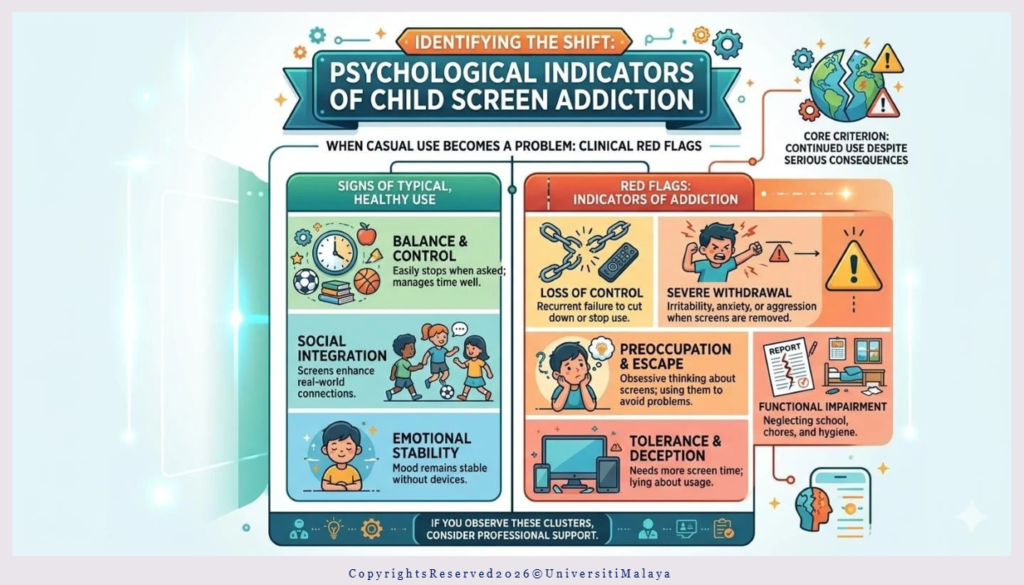
To help you identify whether your child is experiencing healthy usage or heading towards screen addiction, our speakers outlined the following red flags:
| Healthy, Typical Use | Red Flags of Screen Addiction |
| Balance and Control: Easily stops using devices when asked and manages time well. | Loss of Control: Recurrent failure to cut down or restrict device usage. |
| Social Integration: Devices enhance or do not disrupt real-world relationships. | Severe Withdrawal: Irritability, anxiety, or aggression when screens are removed. |
| Emotional Stability: Children remain calm, stable, and anchored across contexts. | Functional Impairment: Neglecting school tasks, household chores, or personal hygiene. |
How Can I Help My Child Defeat the Cycle of Digital Dependency?
To break the cycle of screen addiction, we must first understand the child psychology behind it. Our speakers shed light on the fact that modern digital environments are intentionally engineered by psychological and programming teams to exploit human biology and social vulnerabilities.
By utilising intermittent reward schedules, identical to the mechanics of slot machines or claw crane games, these platforms trigger a dopamine overload. When children feel sad, lonely, or overwhelmed by school and peer pressures, devices offer an immediate escape and an artificial sense of satisfaction. Because this behaviour is instantly rewarded with neurological gratification, it becomes a repetitive cycle that leaves real-world activities feeling mundane by comparison.
To counter this, Prof. Dr Loh introduced actionable, real-world steps for Raising Children with Purpose:
- Establish Tech-Free Zones: Create strict, non-negotiable screen-free zones in your home, such as the dinner table, bedrooms, and during family car rides.
- Protect Bedtime: Keep smartphones and devices completely out of bedrooms overnight to ensure healthy sleep hygiene.
- Create Physical Boundaries as a Parent: Lead by example. Model healthy digital habits by charging your own work phone in a separate room overnight.
- Replace Screen Time with Hobbies: The developing brain needs replacement behaviours. Engaging in reading, hiking, painting, cooking, or any tactile hobby builds new dopamine pathways that do not require a digital screen.
- Schedule Digital Detox Days: Choose one day per week (Sundays work beautifully for most families) to stay completely offline. Research highlights that even a single offline day reduces cortisol stress hormones and significantly boosts creativity.
- Nurture a Value-Driven Identity: Shift your family focus away from what children want to be in the future (such as famous or rich) and focus heavily on who they want to be as individuals (such as kind, empathetic, and resilient).
- Encourage Micro-Contributions: Give your children meaningful household responsibilities. Contributing to the family home builds a deep sense of personal capability, belonging, and real-world impact.
Because sedentary screen habits carry real physical health risks, including a lack of circulation, reduced outdoor play, and an increased risk of childhood obesity, parents can introduce healthy alternatives. Replacing screen time with engaging real-world activities helps reset a child’s dopamine triggers, making offline life feel rewarding again.
Beyond Achievement: Nurturing Character and Intrinsic Value
As an international school community, one of the most resonant themes of the talk was the shared reminder that a child’s ultimate success cannot be measured by a report card alone.
Academic success is only one facet of a child’s life. True success lies in providing emotional safety, deep values, a secure identity, and personal meaning. Purpose gives children direction and lifelong resilience, and strong character matters far more than temporary academic performance. To instill long-term purpose and meet your child’s greatest needs at home, parents can adopt these daily habits:
- Offer Presence Over Entertainment: Children do not merely need to be constantly entertained by external sources or digital tools; they fundamentally crave your physical presence, focused attention, loving guidance, and emotional security.
- Build Strong Emotional Connections Daily: Dedicate focused, high-attention quality time to your child every single day.
- Encourage Service and Empathy: Engage in family activities that promote gratitude, empathy, community service, and inner reflection.
- Help Them Discover Passions: Guide your children to explore their unique personal strengths, creative hobbies, and intrinsic passions.
Empowering Our Parents for the Journey Ahead
The Parenting Talk concluded on a profoundly compassionate and empowering note. Our leadership team extended our warmest thanks to all the parents who prioritised their children’s wellbeing over a long holiday weekend, beautifully showcasing our shared community spirit of continuous learning.
While we as organisers and educators play an essential role in guiding your children during the school day, it is you, the parents, who fundamentally shape their foundational habits, values, and long-term outlook on life. By working hand-in-hand as supportive partners, our families and school can unlock every child’s full potential, ensuring they thrive both in their academic pursuits and in life itself.